

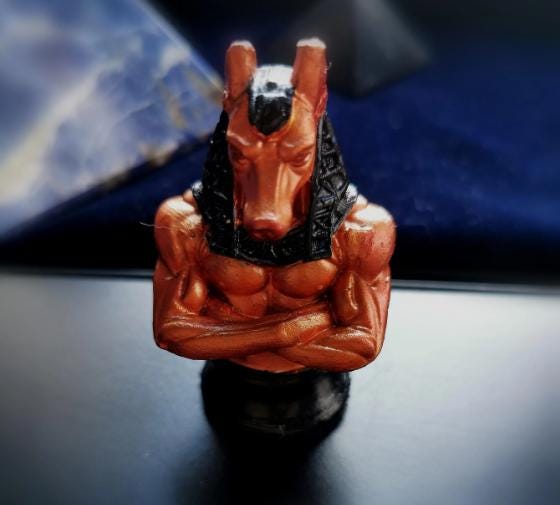
Anubis is one of the oldest known gods in ancient Egyptian religion. His worship can be traced back to the Early Dynastic Period, around 3000 BCE, long before many other well-known Egyptian deities rose to prominence. Early burial sites and funerary texts frequently mention him, suggesting that concerns about death and the afterlife were central to Egyptian life from the beginning. The Egyptians lived along the Nile River, where fertile land supported agriculture. Beyond this green corridor lay the desert, harsh and seemingly lifeless. Tombs were often placed in desert areas, partly because the dry sands helped preserve bodies. Jackals and wild dogs roamed these deserts, sometimes digging into shallow graves. Rather than seeing these animals only as threats, Egyptians incorporated them into their spiritual worldview. They believed that a jackal-headed deity could guard burial grounds and protect the dead from harm. This connection gave rise to Anubis. His jackal form symbolized vigilance and guardianship. Over time, he became associated with mummification, funeral rites, and the safe passage of souls. In early traditions, Anubis was considered the primary ruler of the dead. Later, as religious beliefs evolved, Osiris became the king of the underworld, but Anubis retained his essential role as guide and protector.
Anubis is most commonly depicted with a black jackal head and a human body. The black color is especially meaningful. While black might suggest darkness or death in some cultures, in ancient Egypt it symbolized fertility, rebirth, and the rich soil deposited by the Nile’s floods. Thus, Anubis’s black color connected him not only to death but also to renewal and regeneration. He is often shown holding a flail or a staff, symbols of authority and protection. Sometimes he appears seated atop a shrine, watching over a tomb. In other scenes, he is actively involved in guiding the deceased through the afterlife. These visual elements reinforce key ideas: Anubis is not merely associated with death; he represents order, safety, and transformation. His calm, composed posture contrasts with the fear many people feel toward death, suggesting that the journey beyond life is structured and purposeful.
One of Anubis’s most important roles was as the patron god of embalming and mummification. The Egyptians believed that preserving the body was essential for survival in the afterlife. Without a recognizable body, the soul might become lost or unable to function. Priests who performed mummification rituals often wore jackal masks to represent Anubis. This practice symbolized that the god himself was overseeing the process. According to myth, Anubis embalmed Osiris after his death, setting the precedent for all future funerary rites. This association gives Anubis a deeper spiritual meaning: he represents care during transitions. Mummification was not simply a technical process; it was a ritual of respect, preparation, and transformation. Anubis oversaw the movement from physical life to spiritual existence, ensuring dignity and continuity.
Perhaps the most famous depiction of Anubis appears in the “Weighing of the Heart” ceremony, described in the Book of the Dead. In this scene, the deceased stands before a scale. On one side lies the person’s heart; on the other rests the feather of Ma’at, symbolizing truth and justice. Anubis carefully adjusts the scale, ensuring fairness. If the heart balances with the feather, the soul is judged worthy and allowed to proceed into the afterlife. If the heart is heavier—burdened by wrongdoing—it is devoured by a fearsome creature, and the soul ceases to exist. Anubis’s role here is crucial. He does not judge; rather, he ensures that judgment is fair. This makes him a symbol of balance and impartiality. Spiritually, this scene emphasizes accountability. Life is not random—actions matter, and moral balance determines spiritual outcome.
Another central aspect of Anubis’s identity is his role as a psychopomp—a guide of souls. After death, the journey to the afterlife was believed to be dangerous and confusing. Anubis escorted souls safely, helping them navigate this unfamiliar realm. This guiding function holds profound spiritual significance. Anubis represents the idea that transitions, even difficult ones, are not faced alone. Whether interpreted literally or metaphorically, he embodies support during change. For ancient Egyptians, death was not an ending but a passage, and Anubis ensured that passage was safe. Today, many people interpret this symbolically. Anubis can be seen as representing guidance through personal transformation—moving from one stage of life to another, overcoming fears, or facing uncertainty.
Anubis’s place within Egyptian mythology evolved over time. Early on, he was considered the main god of the dead. Later, Osiris took that position, becoming ruler of the underworld. Rather than disappearing, Anubis’s role shifted. He became Osiris’s assistant, overseeing rituals and guiding souls. He was sometimes described as the son of Osiris and Nephthys, though myths vary. In some stories, he is adopted by Isis. These shifting family relationships reflect the fluid nature of Egyptian mythology, where gods’ roles adapted to changing religious ideas. Spiritually, this flexibility suggests that Anubis represents a function rather than a rigid identity: the function of transition, protection, and guidance.
Anubis was also known as a protector of tombs. Statues of him were placed near burial sites, and prayers invoked his protection against grave robbers or malevolent spirits. His vigilant jackal form symbolized watchfulness. This protective aspect extends beyond physical tombs. Spiritually, Anubis can be seen as guarding boundaries—between life and death, known and unknown, past and future. He represents the idea that sacred transitions deserve respect and protection. In modern interpretations, this symbolism resonates with people navigating change. Anubis becomes a metaphor for safeguarding one’s inner journey, ensuring that transformation happens safely.
Although strongly linked to death, Anubis is ultimately associated with transformation rather than finality. In Egyptian belief, death was part of a cycle. The soul continued, the body was preserved, and rebirth was possible. Anubis facilitated this transformation. He did not end life; he helped reshape it. This aligns with broader Egyptian themes of renewal, seen in the daily rising of the sun and the annual flooding of the Nile. Spiritually, Anubis symbolizes the idea that endings are also beginnings. Change may be intimidating, but it leads to growth. By guiding souls through death, he embodies the hope that transformation leads to something meaningful.
In contemporary spiritual discussions, Anubis is often interpreted symbolically rather than literally. Some see him as representing shadow work—the process of confronting hidden aspects of oneself. Others view him as a protector during emotional transitions. His imagery appears in meditation, art, and personal reflection. People drawn to Anubis often associate him with calm strength, balance, and clarity in uncertain times. He is sometimes seen as a guardian of personal boundaries or a guide through grief. These modern interpretations show how ancient symbols can remain meaningful. Even without belief in the literal mythology, Anubis’s themes—guidance, fairness, protection—continue to resonate.
Anubis has had a lasting impact on popular culture. His image appears in movies, books, and video games, often emphasizing mystery and ancient wisdom. While these portrayals sometimes exaggerate or alter his character, they reflect enduring fascination. This cultural presence keeps his symbolism alive. Each new depiction invites audiences to reconsider what Anubis represents: not simply death, but transition and moral balance.
Ultimately, Anubis embodies universal human concerns. Every culture grapples with questions about death, morality, and what lies beyond. Anubis offers a structured, reassuring perspective: death is a journey, actions matter, and guidance exists. These ideas transcend historical context. Whether viewed religiously, philosophically, or psychologically, Anubis represents order within uncertainty. He stands calmly at the threshold, neither threatening nor sentimental, simply ensuring that the transition is fair and protected.