

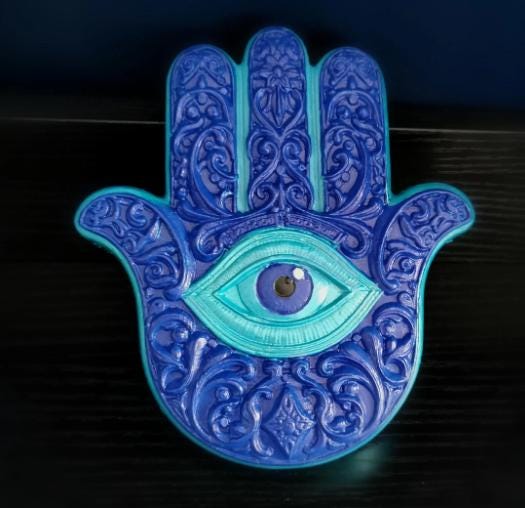
Throughout history, symbols have helped people express protection, hope, and connection to something greater than themselves. One such symbol that continues to appear in jewelry, home décor, art, and spiritual practices is the Hamsa hand. With its distinctive palm shape, often featuring an eye at its center, the Hamsa has traveled across continents and religions, gathering layers of meaning along the way. Today, it is widely recognized as a symbol of protection, blessings, and positive energy. Yet the story behind the Hamsa is richer and more complex than many realize. Understanding its origins and spiritual significance reveals why it remains meaningful to so many people around the world.
The word “Hamsa” comes from a Semitic root meaning “five,” referring to the five fingers of the hand. This simple description hints at one of the symbol’s enduring qualities: it is universal and easy to recognize. The open hand itself is one of humanity’s oldest visual motifs. Long before written language, humans used hand images in cave paintings, marking their presence and identity. Over time, the hand evolved into a powerful symbol associated with strength, protection, and divine presence. The Hamsa is one of the most enduring examples of this transformation.
Historically, the Hamsa is believed to have originated in the ancient Middle East and North Africa. Archaeological evidence suggests that hand-shaped amulets were used in regions such as Mesopotamia, Carthage, and ancient Egypt. These early forms of the symbol were often connected with protection against harm, especially the “evil eye,” a widely held belief that negative intentions or envy could cause misfortune. The idea that a protective charm could deflect harmful energy became deeply embedded in the symbolism of the Hamsa.
In ancient Carthage, for instance, a hand-shaped symbol was associated with the goddess Tanit, who represented fertility, motherhood, and protection. The image of an open hand was believed to invoke divine care and safeguard families and communities. Similarly, in ancient Egypt, protective amulets shaped like hands were linked with blessings, power, and the transmission of spiritual energy. These early interpretations laid the foundation for the meanings that would later develop across religious traditions.
As cultures interacted through trade and migration, the Hamsa spread across the Mediterranean. In Jewish tradition, the symbol came to be known as the “Hand of Miriam,” referring to Miriam, the sister of Moses and Aaron. In this context, the five fingers were sometimes associated with the five books of the Torah, representing spiritual guidance and divine law. The Hamsa was believed to protect against negative influences and invite blessings into the home. It often appeared in household decorations, jewelry, and religious art.In Islamic cultures, the symbol became known as the “Hand of Fatima,” named after Fatima, the daughter of the Prophet Muhammad. Fatima is revered as a figure of patience, compassion, and faith. The five fingers of the Hamsa were sometimes interpreted as representing the Five Pillars of Islam, reinforcing its spiritual significance. Like in Jewish tradition, the Hamsa in Islamic cultures served as a protective emblem against harm, particularly against envy or ill will.It is important to note that the Hamsa’s use across religious boundaries reflects a shared cultural heritage rather than exclusive ownership. Jewish, Muslim, and even some Christian communities have used the symbol in similar ways. This cross-cultural adoption highlights the universal appeal of the Hamsa as a symbol of protection and blessing. Rather than belonging to one tradition, it became a bridge connecting different spiritual perspectives.
One of the most recognizable features of the Hamsa is the eye often depicted in the center of the palm. This “eye” is typically interpreted as a protective gaze, watching over the wearer and warding off negative energy. The concept relates to the belief in the evil eye, which exists in many cultures around the world. According to this belief, jealousy or malicious intent can bring misfortune. The eye within the Hamsa symbolically reflects or neutralizes such negativity, turning harmful energy away.Beyond protection, the Hamsa is also associated with blessings and abundance. The open hand can be seen as a gesture of giving and receiving. Spiritually, it represents openness to goodness, generosity, and compassion. Some interpretations suggest that the Hamsa encourages individuals to live with kindness and awareness, recognizing that positive intentions can shape one’s life and surroundings. In this sense, the symbol is not only defensive but also uplifting.Another spiritual dimension of the Hamsa relates to balance. The symmetry of the hand, often designed so that it can be oriented either up or down, reflects harmony and equilibrium. When the fingers point upward, the Hamsa is commonly interpreted as a sign of protection against negative forces. When pointing downward, it is often seen as inviting blessings, prosperity, and fertility. This dual orientation reinforces the idea that spiritual protection and positive energy are interconnected.The number five itself carries symbolic meaning in many traditions. In addition to its religious interpretations, five can represent the human senses: sight, hearing, touch, taste, and smell. From this perspective, the Hamsa reminds individuals to remain mindful of how they perceive and interact with the world. It encourages awareness and conscious living, suggesting that spiritual growth begins with attentiveness to everyday experience.In contemporary culture, the Hamsa has taken on additional meanings. Many people wear it as a symbol of mindfulness, positivity, and personal protection. It appears in modern jewelry designs, tattoos, and artwork, often blending traditional elements with contemporary aesthetics. For some, it represents cultural heritage; for others, it symbolizes spiritual openness without attachment to a specific religion. This adaptability has contributed to the symbol’s enduring popularity.
Despite its widespread use, the Hamsa continues to carry deep spiritual resonance. People often place it in their homes, particularly near entrances, as a sign of welcome and protection. Others wear it as a necklace or bracelet, believing it brings comfort and reassurance. Whether one views it as a sacred emblem or simply a meaningful symbol, the Hamsa’s presence often inspires reflection on intentions, energy, and connection.The enduring appeal of the Hamsa may lie in its simplicity. The open hand is universally understood as a gesture of peace, trust, and communication. Across cultures, extending an open hand signals goodwill and cooperation. The Hamsa transforms this everyday gesture into a spiritual emblem, reminding individuals of shared humanity and the importance of compassion. Its meaning is accessible, yet layered with centuries of cultural history.From a psychological perspective, symbols like the Hamsa can offer a sense of comfort and control. Believing in protective imagery may help individuals feel more secure in uncertain situations. Even for those who do not hold specific spiritual beliefs, the Hamsa can function as a reminder to focus on positivity and intention. In this way, its impact extends beyond religious boundaries into personal well-being.
The Hamsa also reflects humanity’s long-standing desire for protection and guidance. Throughout history, people have created symbols to express hopes for safety and prosperity. The Hamsa stands among these timeless expressions, carrying forward the collective wisdom of generations. It embodies the idea that spiritual meaning can be shared across cultures, evolving while retaining its core essence.Today, the Hamsa continues to evolve as it moves through global culture. Artists reinterpret it, spiritual practitioners incorporate it into rituals, and individuals adopt it as a personal emblem. Despite these variations, the central themes remain consistent: protection, blessing, and openness. The symbol’s flexibility allows it to resonate with diverse audiences while maintaining its historical roots.In conclusion, the Hamsa hand is far more than a decorative motif. It is a symbol shaped by centuries of cultural exchange and spiritual reflection. From ancient Middle Eastern origins to its role in Jewish and Islamic traditions, the Hamsa has served as a protective emblem and a sign of blessing. Its open palm and central eye communicate ideas of awareness, compassion, and balance. Whether worn as jewelry, displayed in a home, or appreciated as art, the Hamsa invites individuals to reflect on positivity and interconnectedness. Its enduring presence reminds us that symbols can carry shared meaning across time and culture, offering comfort, inspiration, and a sense of unity in a complex world.