

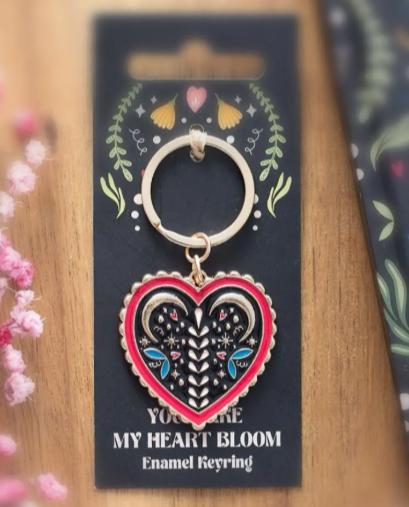
Across cultures and centuries, the heart has served as one of humanity’s most enduring symbols. While the anatomical heart emerged relatively late in medical illustration, the folk heart—a stylized, symmetrical form often rendered in bright colors and decorative motifs—has occupied a central place in vernacular art, ritual practice, and spiritual imagination. Found carved into wooden chests, embroidered on bridal linens, painted on distaffs and ale bowls, cut from paper, or hammered into silver votive offerings, the folk heart represents far more than romantic affection. It is a condensed visual language through which communities have expressed ideas of life, soul, moral character, divine presence, and social bonds. This essay explores the background history and spiritual meaning of the folk heart, tracing its evolution from pre-Christian symbolism through Christian reinterpretation and into modern folk revival contexts. By examining material culture, ritual usage, and symbolic continuity, the essay demonstrates that the folk heart functions as a threshold symbol—bridging body and spirit, individual and community, earthly life and transcendent meaning.
Long before the emergence of Christianity, ancient cultures understood the heart as the seat of life and consciousness. In Indo-European cosmologies, the heart was often associated with breath, warmth, courage, and destiny. Linguistic evidence supports this: words for heart in many languages (Latin cor, Old Norse hjarta, Slavic serce) overlap conceptually with notions of spirit, will, and inner truth. In pre-Christian Europe, symbolic hearts did not yet resemble the modern icon. Instead, heart-like forms appeared as leaf shapes, seeds, drops, or bifurcated ovals, all of which conveyed fertility, regeneration, and continuity. These forms were commonly integrated into agricultural rituals, marriage symbolism, and protective charms. The heart, in this sense, was not a romantic emblem but a cosmic organ—the pulse of life mirrored in the rhythms of seasons, animals, and human kinship. Archaeological findings suggest that amuletic shapes resembling later heart motifs were worn to protect against illness, misfortune, or spiritual harm. These objects were believed to carry apotropaic power, safeguarding the wearer by reinforcing vitality and moral integrity. Thus, from its earliest expressions, the folk heart was already imbued with spiritual significance tied to survival and harmony with unseen forces.
With the spread of Christianity across Europe, indigenous symbols were not erased but reinterpreted. The heart became one of the most potent visual metaphors in Christian theology, representing the inner person—the locus of faith, conscience, and divine encounter. Biblical language reinforced this symbolism: the heart was where God’s law was written, where repentance occurred, and where divine love was received. By the late medieval period, devotional practices increasingly emphasized the interiority of faith, culminating in the widespread veneration of the Sacred Heart of Christ. Although the Sacred Heart is often treated as a distinct theological symbol, its visual and emotional resonance deeply influenced vernacular traditions. Folk artisans adopted the heart motif but simplified it, blending theological meaning with local aesthetics and everyday concerns. In rural communities, carved or painted hearts adorned household objects such as chests, cupboards, and bed frames. These hearts served multiple functions: they were expressions of piety, markers of moral aspiration, and invocations of divine protection over the household. Flames, crosses, rays, or flowers often emerged from the heart, symbolizing love purified through suffering, divine illumination, or spiritual growth. Importantly, the folk heart in Christianized contexts remained relational rather than abstract. It was not merely a sign of Christ’s love but also a reflection of the believer’s heart—open, vulnerable, and oriented toward God and community.
The Folk Heart in Domestic and Social Life
One of the defining characteristics of the folk heart is its embeddedness in daily life. Unlike elite religious art confined to churches, folk hearts circulated in kitchens, bedrooms, barns, and marketplaces. Their presence on everyday objects made spiritual meaning tangible and habitual. In many European traditions, hearts appeared prominently in courtship and marriage rituals. Painted hearts on bridal chests symbolized not only romantic union but also fertility, mutual obligation, and the formation of a new moral household. In Germanic and Scandinavian regions, hearts were often inscribed with initials and dates, transforming them into chronicles of relational history. Similarly, in Slavic and Central European folk art, heart motifs were incorporated into embroidered garments and ceremonial textiles. These hearts were not decorative excess but visual prayers, invoking blessings for health, faithfulness, and continuity of lineage. The repetitive labor of stitching itself functioned as a meditative act, embedding intention into material form. The folk heart also played a role in communal identity. Shared motifs reinforced cultural belonging and transmitted values across generations. Children learned to recognize the heart not simply as a sign of love but as a marker of what it meant to live rightly within the moral universe of the community.
A particularly rich expression of the folk heart appears in the tradition of votive offerings, especially in Catholic regions of Europe and Latin America. Metal hearts—often silver or tin—were offered at shrines in gratitude for healing, protection, or answered prayers. These ex-voto hearts symbolized both the afflicted organ and the entirety of the person’s inner life. In this context, the heart functioned as a currency of exchange between human vulnerability and divine mercy. Offering a heart was a way of externalizing suffering and hope, transforming private experience into communal testimony. The accumulation of such hearts in shrines created collective archives of faith, resilience, and gratitude. Notably, these votive hearts were rarely anatomically precise. Their stylization aligns them with folk aesthetics, emphasizing symbolic meaning over medical accuracy. The heart here represents the whole self offered back to the divine, acknowledging dependence while affirming trust.
Across its many manifestations, the folk heart consistently operates as a threshold symbol. It mediates between opposites: body and soul, suffering and joy, individuality and belonging. This liminal quality accounts for its enduring power. Spiritually, the folk heart signifies openness. Its symmetrical form suggests balance, while its central placement in designs emphasizes orientation toward what is essential. The heart often appears pierced, aflame, or flowering—visual metaphors for transformation through love, sacrifice, or faith. Unlike abstract symbols, the folk heart remains emotionally accessible. Its simplicity invites projection and participation, allowing individuals to locate their own experiences within a shared symbolic framework. This participatory quality aligns with folk spirituality more broadly, which privileges embodied practice, memory, and relational meaning over doctrinal abstraction.
In the nineteenth and twentieth centuries, industrialization and urbanization threatened many folk traditions. Yet the heart motif persisted, often reemerging during periods of cultural revival. Arts and Crafts movements, nationalist folklore projects, and later heritage preservation efforts revalorized the folk heart as a symbol of authenticity and continuity. In contemporary contexts, the folk heart has been reclaimed by designers, tattoo artists, and spiritual practitioners seeking alternatives to mass-produced symbolism. Its appeal lies in its layered meaning—simultaneously personal, cultural, and transcendent. Importantly, modern uses often re-emphasize the heart’s spiritual dimension, even in secular contexts. The folk heart becomes a symbol of wholeness, emotional truth, and ethical orientation in an increasingly fragmented world.
The folk heart is far more than a decorative motif or precursor to modern romantic imagery. It is a symbolic vessel shaped by centuries of spiritual reflection, communal practice, and material creativity. From pre-Christian life-force symbolism through Christian devotion and into contemporary revival, the folk heart has functioned as a visual theology of the human condition. Its endurance testifies to a persistent human need to render the invisible visible—to give form to love, suffering, faith, and hope. For professionals engaged in cultural heritage, design, theology, or anthropology, the folk heart offers a compelling example of how simple forms can carry profound meaning. It reminds us that spirituality often resides not in grand abstraction, but in the humble, handmade symbols that accompany everyday life.