

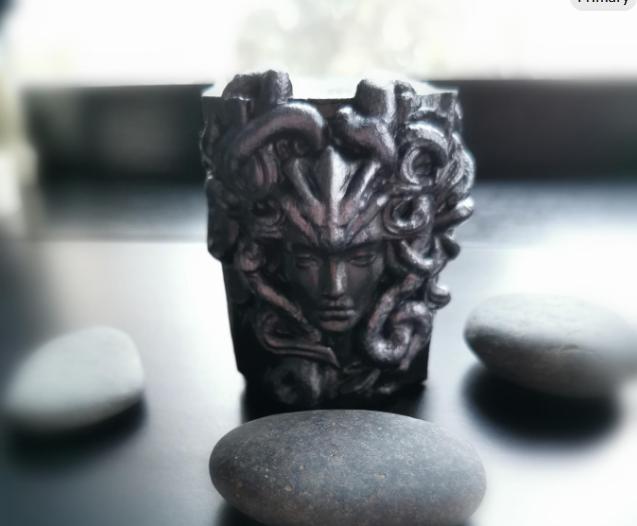
Among the figures of Greek mythology, Medusa stands apart as one of the most enduring, paradoxical, and symbolically rich. Instantly recognizable by her serpent hair and petrifying gaze, Medusa has been interpreted variously as monster, victim, apotropaic symbol, chthonic goddess, and feminist icon. Her myth has traveled across centuries, cultures, and intellectual traditions, accumulating layers of meaning that far exceed her relatively brief appearance in surviving classical texts. For professional readers—historians, classicists, theologians, psychologists, and scholars of religion—Medusa offers a compelling case study in how myth evolves, reflects social structures, and encodes spiritual anxieties.This essay examines Medusa’s mythology through three interrelated lenses: historical development, cultural background, and spiritual meaning. It traces the origins of Medusa from archaic Greek religion through classical literature and Roman reinterpretation; situates her within broader mythological and ritual frameworks; and explores the symbolic and spiritual significance attributed to her across time, including modern psychological and philosophical readings. Rather than treating Medusa as a static figure, this essay emphasizes her mutability—how she mirrors shifting attitudes toward gender, power, sexuality, divinity, and the sacred.
Scholars have long suggested that Medusa’s myth may preserve elements of pre-Hellenic or chthonic religious traditions. The Gorgons—Medusa and her immortal sisters, Stheno and Euryale—are described as dwelling at the edges of the known world, often associated with darkness, the underworld, or the primal chaos preceding Olympian order. This peripheral placement is characteristic of older deities displaced by newer religious systems.Medusa’s association with snakes further supports this interpretation. In many ancient cultures, serpents symbolize earth wisdom, regeneration, and immortality due to their cyclical shedding of skin. Archaeological evidence from Minoan Crete, such as the famous “Snake Goddess” figurines, suggests that snake symbolism was once closely tied to female divinity and fertility cults. Medusa’s serpentine features may therefore echo an earlier goddess figure connected to the earth, death, and rebirth.
One of the earliest and most widespread uses of Medusa’s image is the Gorgoneion—the severed head of Medusa used as a protective talisman. Far from being merely monstrous, the Gorgoneion appears on temples, armor, coins, and household objects throughout archaic Greece. Its function was apotropaic: to ward off evil, avert misfortune, and protect sacred or vulnerable spaces.This protective role complicates later literary portrayals of Medusa as purely malevolent. In early art, her grotesque features—bulging eyes, protruding tongue, tusks—are exaggerated to repel harm. Spiritually, this suggests that Medusa embodied a threshold power: terrifying, but ultimately protective; dangerous, yet sacred. Such figures are common in liminal religious spaces, where the boundary between the human and divine must be fiercely guarded.
The earliest surviving literary account of Medusa appears in Hesiod’s Theogony (c. 8th–7th century BCE). Hesiod describes the Gorgons as daughters of the primordial sea deities Phorcys and Ceto. Unlike her sisters, Medusa is mortal. She is also notable for her sexual encounter with Poseidon, which takes place “in a soft meadow and among spring flowers.” Hesiod does not characterize this encounter as violent, reflecting an earlier mythic sensibility that does not foreground moral judgment.From Medusa’s decapitated body spring Pegasus and Chrysaor, linking her directly to generative and creative forces. This detail underscores Medusa’s dual nature: even in death, she is a source of life and power. Spiritually, this motif aligns her with sacrificial figures whose destruction enables cosmic renewal.
The most influential version of Medusa’s story for later Western tradition comes from the Roman poet Ovid in Metamorphoses (1st century CE). Ovid radically reframes Medusa’s myth, portraying her as a beautiful maiden violated by Neptune (Poseidon) in Athena’s temple. Athena then transforms Medusa’s hair into snakes and renders her gaze lethal as punishment.This version introduces themes of injustice, victimhood, and divine cruelty. Athena’s punishment of Medusa rather than her assailant reflects Roman—and later Christian—moral frameworks that often blame victims of sexual violence. For spiritual interpretation, Ovid’s Medusa becomes a symbol of profaned innocence and the destructive consequences of violating sacred space.Ovid’s moralized narrative profoundly shaped medieval and early modern readings, casting Medusa less as a numinous force and more as a cautionary tale. Yet the emotional resonance of this version also laid the groundwork for later rehabilitations of Medusa as a wronged figure deserving empathy.
The hero Perseus, aided by Athena and Hermes, is tasked with killing Medusa. He uses divine tools—a mirrored shield, winged sandals, a curved sword—to avoid her gaze and decapitate her. The emphasis on indirect vision is symbolically significant: Medusa cannot be confronted directly; she must be mediated, reflected, or intellectually distanced.From a structuralist perspective, Perseus represents Olympian order, rationality, and masculine heroism triumphing over archaic chaos and feminine power. Medusa’s death thus marks a mythic transition from chthonic religiosity to patriarchal divine hierarchy.
Crucially, Medusa’s power does not vanish with her death. Perseus uses her head as a weapon, turning enemies to stone, and ultimately gives it to Athena, who mounts it on her aegis. This incorporation of Medusa into Athena’s iconography suggests assimilation rather than annihilation: the old power is subordinated but preserved.Spiritually, this reflects a recurring mythological pattern in which dangerous sacred forces are contained within socially sanctioned forms. Medusa’s gaze becomes an instrument of divine justice, reinforcing the idea that primordial power must be controlled, not destroyed.
Across traditions, Medusa functions as a liminal figure guarding thresholds—between life and death, sacred and profane, human and divine. Her petrifying gaze halts motion, suspending the viewer in a timeless state. In spiritual terms, this can be interpreted as an encounter with the numinous, in which ordinary consciousness is overwhelmed.Such encounters are not inherently evil; rather, they are transformative and dangerous. Medusa’s gaze forces confrontation with mortality, fear, and the unconscious. This aligns her with initiatory figures who test the spiritual readiness of those who approach them.
Modern spiritual interpretations often reclaim Medusa as an embodiment of suppressed feminine power. Her monstrous appearance reflects cultural anxiety around female autonomy, sexuality, and anger. The snakes—once symbols of wisdom—become signs of demonization when detached from their sacred context.From this perspective, Medusa’s transformation is not a curse but a revelation of latent power. Her gaze enforces boundaries, punishing those who objectify or dominate. Spiritually, she becomes a guardian of bodily and psychic sovereignty.
In depth psychology, Medusa has been interpreted as an archetype of the Terrible Mother or the devouring aspect of the unconscious. Her petrifying gaze represents psychic paralysis when confronted with repressed trauma or overwhelming emotion.However, Jungian and post-Jungian scholars also emphasize integration. To face Medusa indirectly—as Perseus does—is to engage the unconscious symbolically rather than literally, allowing transformation without annihilation. In this reading, Medusa is not an enemy but a necessary encounter on the path to individuation.
In medieval Europe, Medusa was often allegorized as sin, temptation, or the dangers of female beauty. Her gaze symbolized spiritual death through moral corruption. These readings reflect Christian dualism and suspicion of the body, particularly the female body.Yet even in these moralized interpretations, Medusa retained an aura of awe. Her image continued to appear in protective contexts, suggesting that her apotropaic function never fully disappeared.
Renaissance artists and thinkers revisited Medusa with renewed interest in classical antiquity. Caravaggio’s Medusa presents her not as a distant monster but as a moment of raw human terror, collapsing the boundary between victim and villain.Philosophically, Medusa became a metaphor for truth so powerful it overwhelms the observer—a notion later echoed in Enlightenment discussions of the sublime.
In contemporary spiritual discourse, Medusa is frequently invoked in feminist theology, neopaganism, and depth psychology. She symbolizes rage as sacred energy, trauma as initiatory wound, and the necessity of confronting injustice.Medusa’s enduring relevance lies in her refusal to be resolved into a single meaning. She remains simultaneously protector and threat, victim and avenger, monster and goddess. This ambiguity is precisely what grants her spiritual potency.
Medusa’s mythology is not merely a tale of a monster slain by a hero; it is a palimpsest of religious transformation, cultural anxiety, and spiritual symbolism. From her probable origins as a chthonic guardian figure to her classical demonization and modern reclamation, Medusa reflects the shifting boundaries of the sacred.