

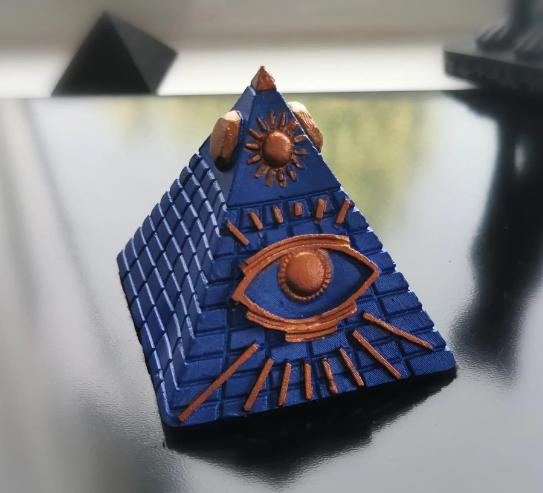
Few symbols have sparked as much curiosity, speculation, and fascination as the Eye of Providence. Often depicted as a single eye enclosed within a triangle and surrounded by rays of light, the symbol appears on buildings, religious art, currency, and popular culture. Some see it as a sign of divine protection, others as a philosophical reminder of moral accountability, and still others as a mysterious emblem surrounded by conspiracy theories. Yet behind the myths and modern interpretations lies a long and meaningful history rooted in spirituality, religion, and human reflection on the nature of the divine.
The idea of an all-seeing eye predates Christianity by thousands of years. Ancient civilizations frequently used eye imagery to represent awareness, protection, and divine power. One of the earliest examples is the Eye of Horus in ancient Egypt. This symbol represented healing, protection, and royal authority, and it was believed to safeguard both the living and the dead. Although visually different from the Eye of Providence, the shared theme of divine watchfulness connects the two. In ancient Greece and Rome, eyes were sometimes placed on shields, ships, and temples to ward off evil and symbolize vigilance. These early uses reflect a universal human idea: the belief that higher powers observe the world and maintain cosmic order.
The Eye of Providence as we recognize it today developed primarily within Christian theology and art during the Renaissance. The symbol was used to represent God’s omniscience—the belief that God sees all things, knows all thoughts, and is present everywhere. The triangle surrounding the eye came to symbolize the Holy Trinity: the Father, the Son, and the Holy Spirit. During the 16th and 17th centuries, European churches began incorporating the Eye of Providence into paintings, stained glass, and architecture. It often appeared above altars or at the apex of domes, visually reinforcing the idea that God watches over worshippers and the world below. The rays of light emanating from the eye symbolized divine illumination, truth, and grace flowing into human existence. Importantly, in this religious context, the symbol was not meant to inspire fear. Rather, it conveyed reassurance—that God’s watchful presence was protective, guiding, and loving.
As Europe entered the Age of Enlightenment, the Eye of Providence took on additional layers of meaning. Philosophers of the time emphasized reason, moral responsibility, and universal natural laws. The symbol began to represent not only God’s presence but also the idea that human actions matter, even when no one else is watching. This interpretation aligned well with moral philosophy: the belief that ethical behavior should come from internal conviction rather than external enforcement. The Eye became a reminder that truth and justice transcend human institutions.
One of the most famous appearances of the Eye of Providence is on the Great Seal of the United States, adopted in 1782. The eye appears above an unfinished pyramid, accompanied by the Latin phrases Annuit Coeptis (“He approves our undertakings”) and Novus Ordo Seclorum (“A new order of the ages”). In this context, the symbol reflected the Founding Fathers’ belief in divine guidance, not divine control. Many of them held deist views, believing in a higher intelligence that set the universe in motion but allowed humanity to exercise free will. The unfinished pyramid symbolized strength and endurance, while the Eye represented hope that the nation’s efforts aligned with higher moral principles. It was not a declaration of secret power, but a public statement of humility: that even a new nation remained accountable to something greater than itself.
Spiritually, the Eye of Providence speaks to a deeply human experience—the awareness of being seen, known, and connected. Across cultures, this idea appears in different forms: divine witnesses, cosmic consciousness, or universal awareness. At its core, the symbol conveys three interconnected spiritual meanings:
1. Awareness and Consciousness The eye represents awakening—seeing beyond illusion and recognizing deeper truths. Spiritually, it encourages individuals to examine their inner lives, intentions, and actions with honesty.
2. Guidance and Protection Rather than surveillance, the eye suggests care. Many spiritual interpretations view it as a symbol of reassurance, implying that individuals are not alone and that their struggles are seen.
3. Moral Responsibility The Eye of Providence reminds people that actions have meaning beyond immediate consequences. It encourages integrity, compassion, and accountability, even in solitude.
In recent decades, the Eye of Providence has become entangled with conspiracy theories, often linked to secret societies or hidden power structures. While groups such as Freemasons have used eye symbolism, historians widely agree that the Eye of Providence was a common and widely understood symbol long before these associations. The persistence of these misconceptions speaks less to the symbol itself and more to modern anxieties about power, control, and transparency. Symbols endure because they are flexible, capable of absorbing the fears and hopes of each generation.
Today, the Eye of Providence continues to resonate because it addresses timeless questions: Who watches over us? Are our lives meaningful? Do our choices matter?
Whether interpreted religiously, philosophically, or metaphorically, the symbol invites reflection rather than certainty. It does not demand a single belief system but encourages awareness—of self, of others, and of the larger forces shaping existence. In a world increasingly driven by distraction and external validation, the Eye of Providence quietly reminds us to look inward, act with integrity, and recognize that meaning often begins with awareness.