

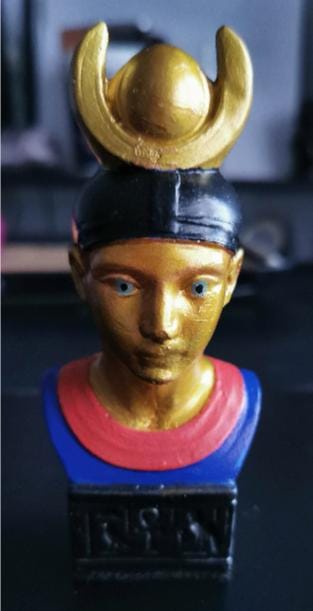
In ancient Egypt, art was never merely decorative. Every image, monument, and statue carried religious meaning and cosmic purpose. Among the most powerful of these artistic forms were statues of the pharaoh. Far more than representations of political authority, pharaoh statues functioned as sacred objects deeply embedded in Egyptian spiritual beliefs. They served as vessels for divine presence, tools for maintaining cosmic order, and bridges between the human and the divine. Understanding the spiritual significance of pharaoh statues offers insight into how ancient Egyptians viewed kingship, the afterlife, and the structure of the universe itself.
At the heart of Egyptian belief was the concept of divine kingship. The pharaoh was not simply a ruler chosen by the gods; he was considered a god in human form. During his lifetime, the pharaoh was associated with Horus, the falcon god of kingship and the sky. After death, he became identified with Osiris, the god of the afterlife and resurrection. Statues of the pharaoh embodied this divine identity. They were created not only to show what the ruler looked like, but to manifest his sacred nature in permanent, physical form. This belief explains why pharaoh statues are characterized by an idealized, timeless appearance. Rather than showing aging, emotion, or individuality, they emphasize stability, symmetry, and perfection. These qualities reflected the Egyptian concept of ma’at, the cosmic order that governed the universe. The pharaoh was responsible for upholding ma’at, maintaining balance between chaos and harmony. A statue that conveyed calm strength and eternal youth symbolized a ruler capable of fulfilling this divine duty for all time. Spiritually, statues were believed to house the ka, one of the essential components of the soul. The ka represented a person’s life force or spiritual double, and it required a physical dwelling in order to survive after death. While the mummified body was the primary home of the ka, statues served as alternative vessels. If the body was damaged or destroyed, the ka could inhabit the statue instead. For this reason, statues were not passive memorials; they were active participants in the afterlife. Offerings of food, drink, and incense were presented to statues so that the ka of the pharaoh could continue to be nourished eternally. The placement of pharaoh statues further emphasizes their spiritual role. Many were located in temples, where they participated in ritual life. In these sacred spaces, statues were treated almost as living beings. Priests washed them, dressed them, and presented offerings daily. Through ritual, the statue became a point of contact between the gods and the people. When worshippers prayed before a statue of the pharaoh, they were not merely honoring a former king; they were addressing a divine intermediary capable of influencing the gods on their behalf. Pharaoh statues also played a crucial role in reinforcing the pharaoh’s cosmic authority. Colossal statues, such as those of Ramses II at Abu Simbel, were deliberately monumental in scale. Their immense size conveyed not only political dominance but spiritual power. By dwarfing the human viewer, these statues visually expressed the idea that the pharaoh existed on a higher plane of being, closer to the gods than ordinary mortals. The immovable stone suggested permanence, reinforcing the belief that the pharaoh’s divine presence would endure forever. Symbols incorporated into pharaoh statues carried layered spiritual meanings.
The nemes headdress, often worn by pharaohs in statues, signified royal authority and divine protection.
The uraeus, the cobra displayed on the forehead, represented the goddess Wadjet and symbolized divine power capable of destroying enemies. Even posture conveyed meaning: seated statues communicated stability and judgment, while standing statues suggested active guardianship and eternal vigilance. Each artistic choice reinforced the statue’s role as a sacred object rather than a simple portrait. In funerary contexts, pharaoh statues were especially important. They were placed in tombs and mortuary temples to ensure the continued existence of the ruler in the afterlife. These statues allowed the deceased pharaoh to receive offerings, participate in rituals, and maintain influence in both the divine and earthly realms. Mortuary temples themselves were designed as spaces where the living could interact with the eternal spirit of the king, blurring the boundary between life and death. The spiritual significance of pharaoh statues also extended to the wider population. Ordinary Egyptians believed that the pharaoh’s well-being was directly tied to the prosperity of the land. A spiritually powerful statue helped ensure good harvests, protection from chaos, and the favor of the gods. In this way, the statue was not only for the pharaoh’s benefit but for the survival of the entire civilization. In conclusion, pharaoh statues were among the most spiritually charged objects in ancient Egyptian culture. They embodied divine kingship, served as vessels for the soul, upheld cosmic order, and acted as intermediaries between gods and humans. Their idealized forms, symbolic elements, and ritual treatment reveal a worldview in which art, religion, and politics were inseparable. To the ancient Egyptians, a statue of the pharaoh was not stone given shape, but a living presence infused with sacred power—an eternal guardian of order, balance, and divine connection.