

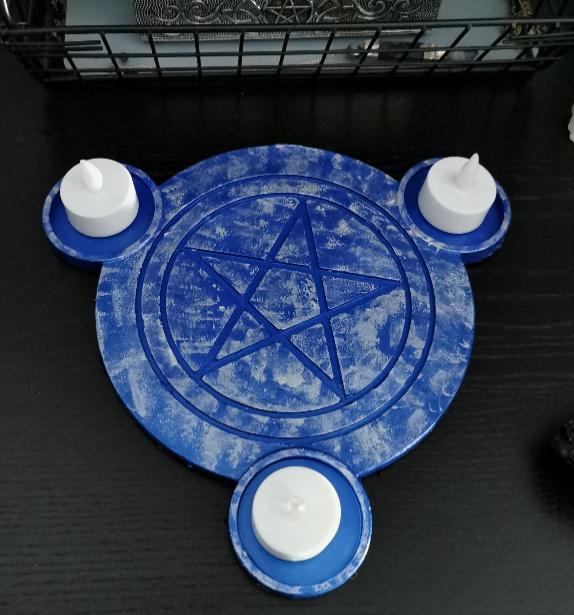
The earliest known use of the pentagram dates back over 5,000 years to ancient Mesopotamia. Archaeological evidence shows that the symbol appeared in Sumerian and Babylonian inscriptions as early as 3000 BCE. In these civilizations, the pentagram was not primarily religious but was used as a pictographic symbol associated with directions, celestial bodies, or royal authority. Some scholars believe it represented the five visible planets known at the time or the concept of cosmic order. In ancient Greece, the pentagram gained mathematical and philosophical significance. The Pythagoreans, followers of the philosopher Pythagoras, revered the pentagram as a symbol of perfection and balance. They called it the “pentalpha,” as it could be formed from five Greek alpha (Α) shapes. For the Pythagoreans, the pentagram represented health, harmony, and the unity of the universe. Its proportions also contain the golden ratio, reinforcing its association with aesthetic and mathematical perfection.
The pentagram also appeared in early religious traditions, including Judaism and Christianity. In ancient Hebrew contexts, the pentagram was sometimes used as a protective symbol and was associated with truth. Some interpretations connect it to the Pentateuch—the first five books of the Hebrew Bible. In early Christian symbolism, the pentagram represented the five wounds of Christ (hands, feet, and side) and was used as a sign of divine protection and faith. During the Middle Ages, the pentagram was commonly viewed as a positive symbol. Medieval Christians often associated it with virtues such as truth, loyalty, and purity. It appeared in churches, manuscripts, and architecture. One famous example is the medieval poem Sir Gawain and the Green Knight, in which the pentagram on Gawain’s shield symbolizes moral perfection and spiritual integrity.
The perception of the pentagram began to change during the late medieval and early modern periods. As Europe experienced religious upheaval, witch hunts, and growing suspicion toward mystical or non-conforming beliefs, symbols associated with esoteric knowledge became stigmatized. By the 19th century, the inverted pentagram—where one point faces downward—was increasingly linked to occultism and later to Satanism. This association was largely shaped by writers and occultists such as Éliphas Lévi, who suggested symbolic meanings tied to moral inversion. It is important to note that the inverted pentagram does not historically represent evil across most cultures. The negative connotations are relatively recent and primarily rooted in Western Christian fear of alternative spiritual systems. Popular media in the 20th and 21st centuries further reinforced these misconceptions by portraying the pentagram as a symbol of darkness or malevolence.
At its core, the pentagram carries profound spiritual symbolism. One of its most common interpretations relates to the five elements: earth, air, fire, water, and spirit. In this framework, each point of the star represents one element, with spirit typically placed at the top, signifying the dominance of consciousness or the divine over material existence. This elemental symbolism is especially prominent in modern pagan and Wiccan traditions. The pentagram is also widely regarded as a symbol of protection. Throughout history, it has been used as a talisman to ward off evil or negative influences. The continuous, unbroken line that forms the pentagram represents unity, eternity, and the interconnectedness of all things. Spiritually, this suggests that life is a harmonious whole rather than a collection of isolated parts. Another important spiritual interpretation of the pentagram is its representation of the human being. When overlaid on the human form, the five points correspond to the head, arms, and legs, symbolizing humanity’s place within the cosmos. This idea reflects the ancient philosophical belief that humans are a microcosm of the universe—a small reflection of the greater whole.
In contemporary spiritual practices, particularly within Wicca, Neopaganism, and some forms of modern witchcraft, the pentagram is reclaimed as a sacred and positive symbol. It represents balance, spiritual growth, respect for nature, and ethical living. Many practitioners emphasize that the pentagram is not a symbol of harm but of reverence for life and the natural world. The pentagram has also found meaning outside of religion, appearing in art, literature, and popular culture as a symbol of mystery, individuality, or rebellion. While its use varies widely, its enduring presence demonstrates its powerful symbolic resonance across time and belief systems.